Why a Kerb Edge Helps a Street Read as a Sequence
See how a kerb edge helps a street read as a sequence, linking entrances and crossings so people can tell where the pavement ends and vehicles pass.
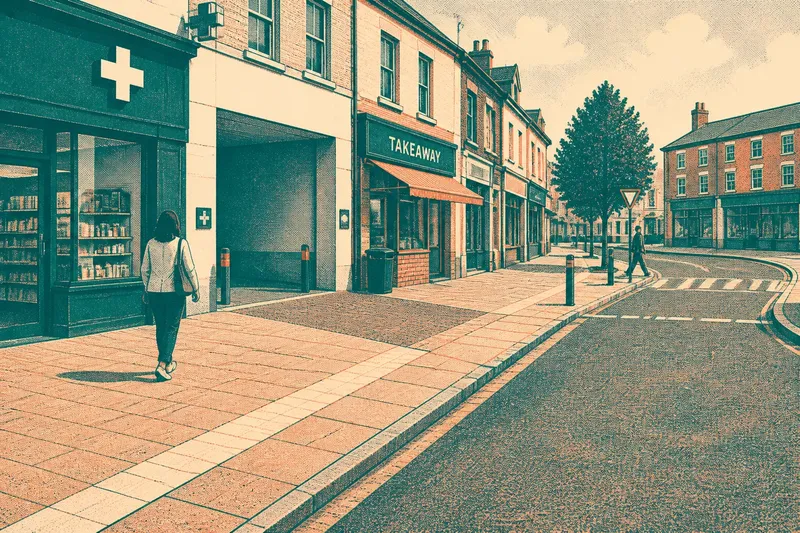
A kerb edge helps a street read as a sequence by making the boundary between pavement and carriageway easier to follow. At a corner shop, a recessed doorway and a side-road entrance, that line can clarify where pedestrians continue and where vehicles cross their path.
Imagine a hypothetical high street with a pharmacy, a takeaway and a narrow side road. The pavement runs past each shop, but a wide vehicle entrance beside the pharmacy and a sloped junction mouth make the walking space look as if it stops and restarts. The design task is to make those different thresholds understandable without treating every frontage alike.
What does a kerb edge communicate?
A kerb marks a change in level and use: pavement on one side, carriageway on the other. Its alignment gives a walker a reference line, while its height and material help distinguish the pedestrian area from space used by vehicles.
Continuity does not require an unbroken raised barrier. At a driveway or side road, the kerb may lower or disappear to provide access. The crossing can still read as a break in the vehicle boundary rather than the end of the pavement if the walking surface remains visually coherent.
That distinction is especially useful where shop entrances sit close together. A steady edge gives the street structure; changes in doors, windows and signs can then provide local character without making the route seem to fragment.
Where can the street’s boundary become unclear?
In the imagined high street, the pharmacy entrance has a broad apron of paving that matches the carriageway. From the opposite pavement, it appears to be an extension of the road. The shopfront itself is easy to spot, but the pedestrian path across the entrance is not.
At the takeaway, the doorway is recessed behind a narrow forecourt. A short section of wall and a drain cover interrupt the line of the kerb, while the side-road mouth further along has a flush transition. Each feature has a reason to be there; together, they offer no consistent clue about the pavement’s edge.
To inspect this kind of street, walk both directions and note where the kerb changes height, alignment or material. Also look from the approach to each crossing: a detail that seems clear from beside it may disappear when viewed from further away.
How can a design preserve a readable edge?
One option is to carry a consistent paving band or joint along the pavement, including across vehicle entrances. The band should be part of the walking surface, not a decorative stripe that could be mistaken for a separate route or hazard.
At the pharmacy, the vehicle apron could use a different surface from the pavement while a clear pedestrian line continues across it. At the side road, the kerb alignment and crossing treatment can make the turning movement legible while showing that people on foot still have a continuous path. The precise arrangement depends on access, drainage, maintenance and local standards, so consult relevant guidance and a qualified street designer before specifying details.
Say the hypothetical design team has a plan showing a pale paving strip that stops at the pharmacy apron. They trace the pedestrian route across the entrance, extend the strip through the crossing, and review the junction approach drawing. The resulting plan shows one uninterrupted walking line and a distinct vehicle crossing; if the two still merge visually, the team can revise the materials or alignment before construction.
What should an on-foot review check?
- Check whether the kerb line is visible along the block; if it disappears without a clear transition, revise the alignment or add a consistent paving cue.
- Check whether a driveway surface looks like an extension of the carriageway; if it does, distinguish the pedestrian path with coherent paving, or consult an access specialist if that treatment conflicts with access needs.
- Check whether a recessed entrance draws pedestrians into the vehicle area; if it does, clarify the forecourt boundary, or adjust the entrance paving when the building layout allows.
- Check whether a drain cover interrupts the walking line; if it does, reposition the line in the design or coordinate the paving and drainage layout.
- Check whether the side-road crossing makes the pedestrian route hard to identify; if it does, review the kerb transition and surface treatment against local standards, or seek advice from the responsible highway authority.
- Check the street from both directions and from the approach to each opening; if the route reads differently from either view, revise the cue or alignment, or retain the design only if both views remain clear.
What questions do people ask about kerb edges?
Does a kerb have to stay raised along the whole pavement?
No. Driveways, crossings and entrances may need a lowered or flush transition. The design should still make the walking route and the vehicle crossing distinguishable, in line with access requirements and local guidance.
How can a driveway look less like a break in the pavement?
Keep a clear pedestrian line across the entrance, using paving or alignment that relates to the adjoining footway. If a proposed surface cue could confuse users or conflict with access needs, ask an access professional to review it.
Should every shopfront use the same kerb detail?
No. A consistent overall boundary can accommodate different entrances, loading points and forecourts. Use local changes where the function changes, while keeping the pedestrian route legible from the street.
What can replace a kerb cue at a flush crossing?
A carefully chosen change in paving direction, texture or material can help indicate the boundary when a raised kerb is unsuitable. Check the proposed cue against access standards and the needs of people with limited vision or mobility.
How does a clear edge support different frontages?
A pharmacy, a takeaway and a side-road entrance each bring a different movement to the pavement: stopping at a door, queuing briefly or crossing the footway by vehicle. A consistent boundary helps those activities coexist without requiring identical frontage designs.
When reviewing a kerb edge, start with the walking line and ask what each change tells someone approaching it. For this kind of street, a useful design decision is often to make the crossing legible as a crossing while keeping the pavement recognisable on both sides.